
Underground Drainage Systems Built for Florida Rain
Every time it storms, your roof collects hundreds of gallons of water and your downspouts drop all of it right beside the house. An underground drainage system catches that water at the wall, carries it through sealed pipes buried under the yard, and releases it at a safe discharge point away from your home.
Trufam builds these systems with solid SDR-35 pipe, real access points, and a discharge sized for the storm, not just for a sunny day. Most homeowners who call us have already paid once for a cheap fix that failed. We build it right the first time.
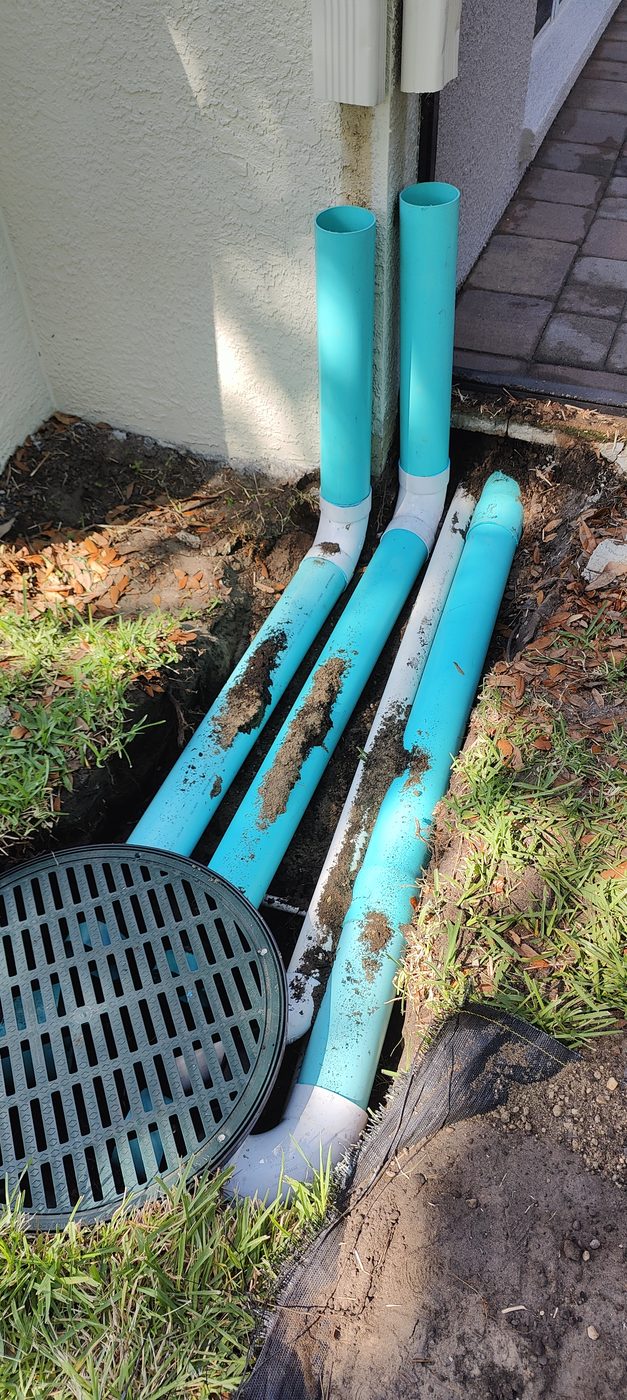
Your Downspouts Are Pouring Water at Your House
One inch of rain on an average roof is well over a thousand gallons of water, and Tampa Bay gets around fifty inches a year, most of it in hard summer bursts. Without somewhere to go, all of that water lands in the few feet of ground right around your foundation.
That is where the damage starts. The soil along the house stays soaked, mulch and sand wash out a little more with every storm, and water creeps toward the slab, the garage, and the lanai. The lawn between houses turns into a soggy strip that never fully dries.
An underground drainage system ends that cycle. It picks the water up at each downspout, moves it through sealed pipe under the yard, and gives it one controlled exit away from everything you are trying to protect.
When You Need Underground Drainage
- Downspouts dumping right at the foundation
- Trenches and washout lines under each downspout
- Mulch or sand washing out of the beds every storm
- Water pooling on walkways, patios, or the pool deck
- A soggy strip of lawn that never dries out
- Water pushing into the garage or lanai in heavy rain
- Stains or constant damp along the slab edge
- Splash blocks and extensions that never solved it
The Path Water Takes Through a Trufam System
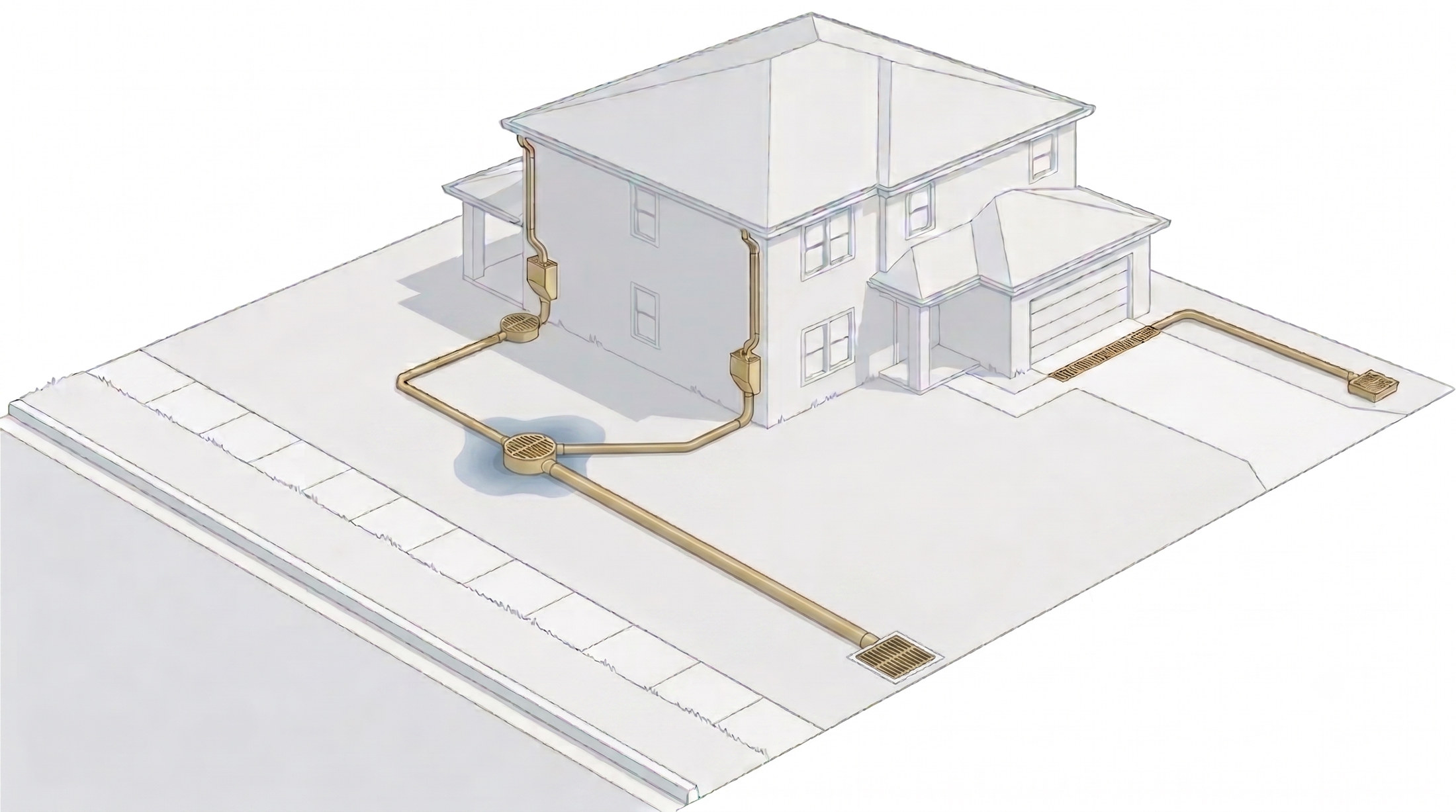
From the moment rain leaves your roof to the moment it exits the property, every step has a job. The numbers on the diagram match the steps below.
 1
2
3
4
5
6
7
7
1
2
3
4
5
6
7
7
Seamless gutters
The system starts at the roof edge. Gutters catch the rain coming off the roof and feed it to the downspouts, and they have to be sized, pitched, and sealed right to keep up with a Florida storm. If your gutters are undersized or pulling away, we address them in the same project.
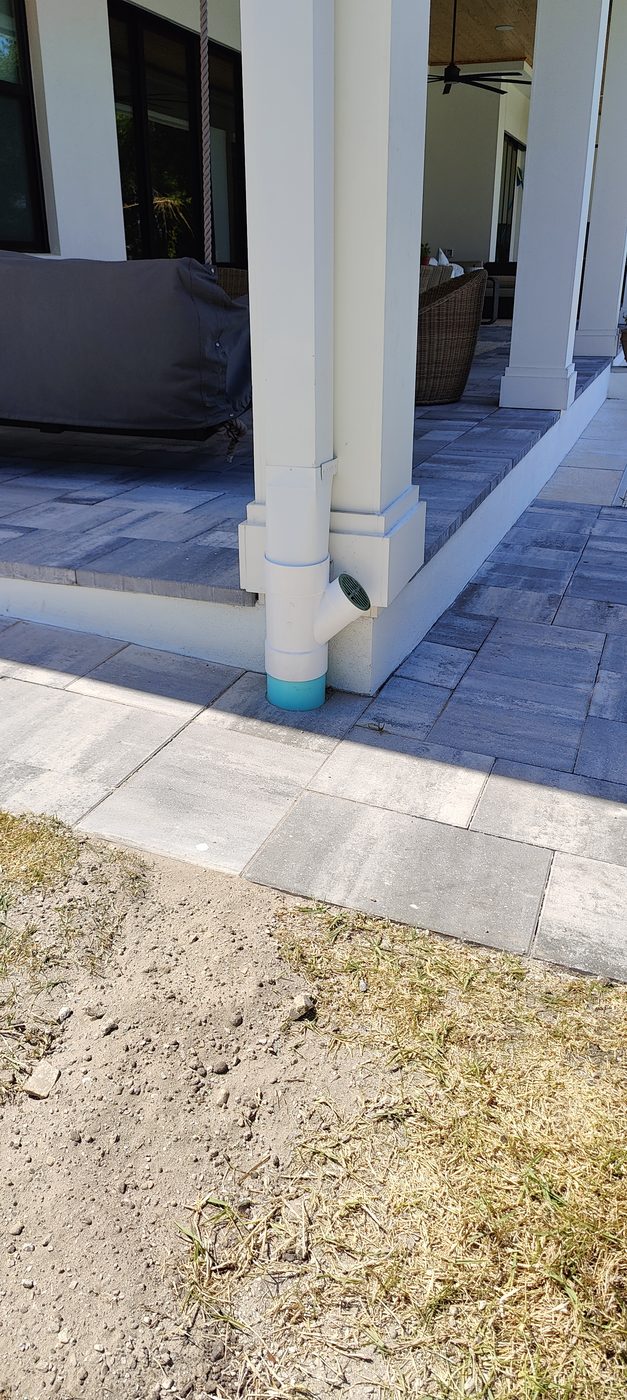
Metal downspout cleanouts
Each downspout ties into a metal cleanout mounted at the wall, with a stainless steel screen inside. It catches leaves and debris before they enter the pipe, vents the line so water flows fast, and gives us an access point for future service.
Sediment basins
Roof water carries shingle grit, and surface inlets pick up sand and dirt. Sediment basins sit after those entry points and trap the heavy material in one easy-to-clean spot, so it never settles inside the buried pipe.
Distribution box
The downspout lines meet at a grated distribution box, sized 20 or 24 inches depending on the system. It collects everything into the main line and doubles as a surface inlet and service access point at the heart of the system.
Sealed solid pipe runs
The water moves through solid SDR-35 PVC in long 20-foot sections, set on flat trench bottoms with proper pitch we check with a level. Fewer joints and no low spots means nothing for water to leak through and nowhere for it to sit.
Surface water tie-ins
Where water pools on hard surfaces or low spots, we tie in channel drains and grated inlets, on their own runs or into the main system, so the same buried network handles surface water too, not just the roof.
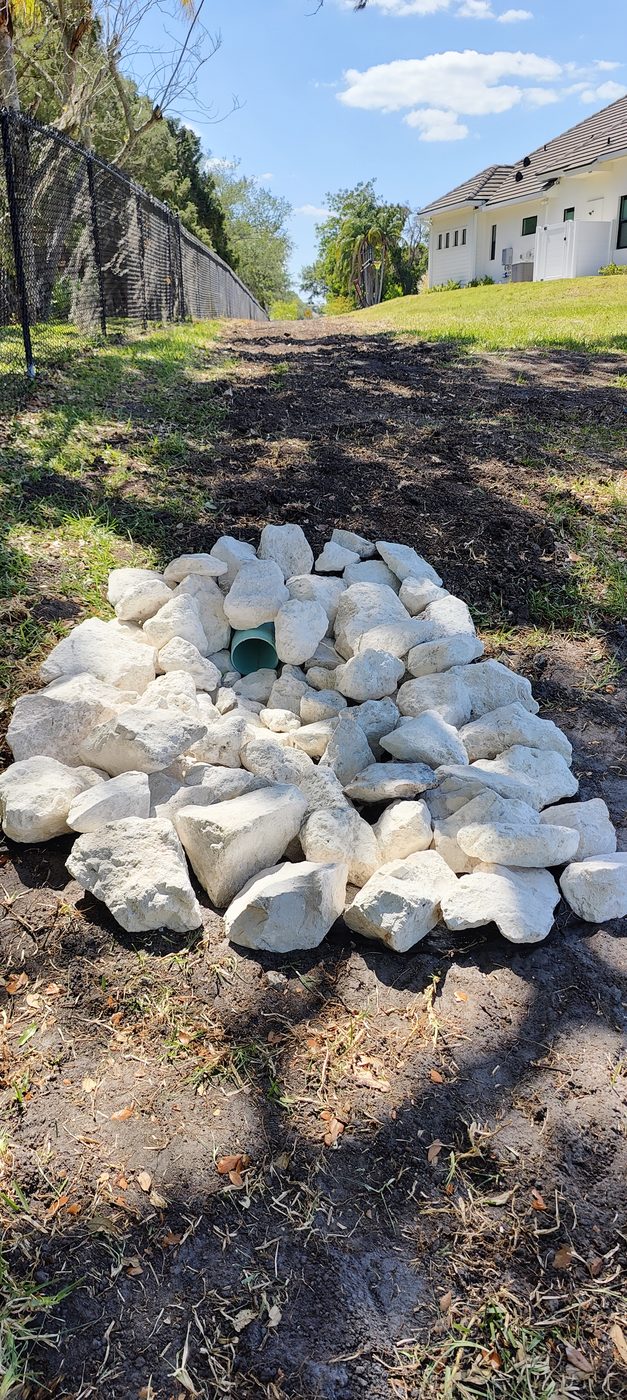
A discharge built for storms
Every run ends at a controlled exit: a daylight outlet, a grated discharge basin, or a high-flow outlet basin, often protected with rip rap stone so the exit never erodes. We do not end a system at a pop-up emitter, which restricts flow and clogs.
Solid SDR-35 Pipe, Never Cheap Corrugated
Most drainage failures we dig up in Tampa Bay come down to the same material: thin corrugated pipe. Every ridge inside it traps shingle gravel and silt, roots punch through the thin wall, and it crushes under lawn equipment. We have pulled out corrugated lines packed completely solid.
Trufam runs solid SDR-35 PVC instead. It is the same class of pipe used in commercial storm systems: thick-walled, smooth inside so debris flushes through, and strong enough to last underground for decades. It costs more than corrugated, and it is the single biggest reason our systems keep working.
Long sections mean fewer joints, and fewer joints mean fewer places for a system to separate, leak, or let roots in.
We set pipe on flat trench bottoms and check the fall with a level, so there are no low spots where water and sediment can sit between storms.
A Trufam system empties completely between storms. A dry pipe does not breed mosquitoes, does not invite roots, and does not collect standing sediment.
Cleanouts, basins, and boxes are placed so the whole system can be inspected and serviced for life, without digging up the yard to find a problem.
Drainage That Is Designed, Not Guessed
Before we quote anything, we walk the property and read the water: how much roof feeds each downspout, where the surface water collects, how the lot falls, and where a discharge can safely go. Then we size every pipe, basin, and box to match. Gravity does the work wherever possible, and we only bring in a sump pump system when the grades leave no other way out.
We are not the lowest bid, and we do not try to be. You are paying for the experience to know what type of system your property needs, the skill to install it properly, and commercial-grade pipe with serviceable access points. That is what protects the much larger investment sitting on top of it, your home.
Underground drainage also pairs with the rest of a water plan. A French drain handles water that has already soaked into the ground, and foundation drains protect the house itself when water is reaching the slab.
What You Get With Trufam
- A system designed and sized to your property
- Solid SDR-35 pipe, never corrugated
- Metal downspout cleanouts with debris screens
- Sediment basins that keep the pipes clean
- Gravity-fed design, sump pumps only when needed
- A controlled discharge, not a pop-up emitter
Which System Does Your Property Need?
If you do not work in drainage every day, it is natural to lump all of this together under one name. Each system handles a different kind of water, and the right answer for many Tampa Bay homes is more than one of them working together.
Underground drainage
Sealed solid pipe that captures roof and surface water at downspouts and inlets, then carries it off to one controlled discharge. The system this page covers.
Best for: downspout runoff, washout, and water pooling near the house.
French drain
Perforated pipe in a fabric-wrapped granite trench that pulls out water already soaked into the ground, the water you cannot see falling.
Best for: soggy lawns and high groundwater. See French drains.
Channel drain
A surface drain set into concrete or pavers that catches water sheeting across driveways and pool decks before it reaches the structure.
Best for: hard surfaces that pool. See channel drains.
What Shapes the Scope and the Price
Every system is sized to the property, so every project is scoped on its own. The drivers are simple: how much water the roof and the lot produce, how many places we have to pick it up, and how far it has to travel to leave safely.
Premium drainage built to last is an investment, and we price it that way. At the walkthrough we lay out exactly what we would build, what each piece does, and why it belongs in the design before any number is set.
- How many downspouts and inlets tie into the system
- Total length and depth of the pipe runs
- Basins, boxes, and access points the design calls for
- Distance to a safe discharge and how the lot falls
- Concrete, pavers, or roots along the route
- Sod and surface restoration when the work is done
Underground Drainage Projects in Tampa Bay
Why Underground Drainage Matters on Florida Lots
Tampa Bay lots are flat, so roof water does not run off on its own. The summer pattern drops an inch or two of rain in an afternoon, day after day, and the ground never gets a chance to catch up. On lots this flat, the difference between a dry slab and a wet one is whether the downspout water gets picked up and carried away or left to soak in beside the house.
We design and install underground drainage across Palm Harbor, Clearwater, Dunedin, Safety Harbor, St. Petersburg, Seminole, Tampa, Fish Hawk, Bradenton, Lakewood Ranch, Sarasota, and the surrounding communities. See every area we cover on our service areas page.